.png)
Ulrich Köhler's "Gavagai" – A journey from the sets of Medea to Berlin

The name of the movie “Gavagai” comes from a well-known thought experiment from philosopher W.V.O. Quine about the inability to translate a certain sentence and word perfectly. A correct point of entry into the newest movie by Ulrich Kohler, which focuses on the fields between languages, cultures, and intentions. In this co-production between Germany and France, Kohler turns a film-within-a-film into a tale of cross-cultural romance and much more.
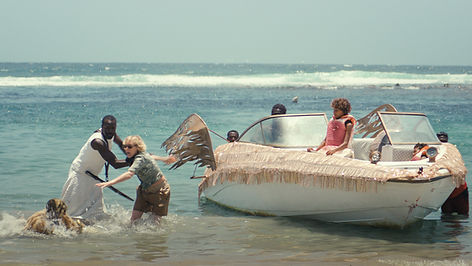
The plot is set in two different environments that almost serve as two different acts. Stories, we have heard of the making of many Hollywood films, where two lead actors of a film, have a secret relationship. Similarly, here, a European staging of Medea in Senegal is uncontrollably creative, with the lead actors, Maja (Maren Eggert) and Nourou (Jean-Christophe Folly) becoming unexpectedly intimate in the middle of a film in production. Several months after, at the Berlin premiere of the film, their reunion causes them to reconnect with passion and tension complicated once again by a racist security incident (a scene which is heavily inspired by Kohler and Folly’s personal experience in Berlin) which leaves the characters, with the uncomfortable questions of power and privilege in the modern cultural spaces. The film also shares light as to how Nourou feels responsible, when the person responsible for the racist incident is fired and eventually him trying to confront the security officer at the later part of the film.
The casting is especially great. Maren Eggert has a difficult task of balancing the tricky landscape of a character who is protective of her co-star, who is both nurturing and yet complex in her power structures. Jean-Christophe Folly has been received as a quite powerful voice in the first reviews, their relationships develop persuasively on a professional relationship into passionate love, then the tense relationship of Berlin reunion.
Gavagai visually has done great contrasts between the two settings. The Senegal sequences are full of colours and improvisation and they capture the sea and the coastline besides the tension of cultural clash. The opening scenes in Berlin become colder and more restrained in their aesthetics that reflect the social tensions festering under facades of courtesy. This change of geography and tonality serves to further develop the theme of meaning as contextualized in the film.
The only thing that makes Gavagai especially pertinent to the audiences of the festival in 2025 is that it is not afraid to look at the complicity of the film industry in the cultural dynamics that it depicts. Instead of providing a quick fix to the issues of racism, representation, or cross-cultural romance, Kohler leaves audiences to grapple with the issues that do not have a simple answer.
To DIFF viewers who want to watch a film that challenges, and yet entertains, Gavagai does provide a glimpse into the deep and uncomfortable world where comprehension is always just beyond their grasp; as the word, which is inexplicable and that the film is named, itself.


Users searching 192.168.o.1 tenda may want to change Wi-Fi or router settings. Before accessing the administration page, confirm the correct numeric IP and make sure your device is connected to the Tenda network.
The similarity between 10.0.0.0.1 and other router addresses can easily confuse someone who is new to networking. I think a good explanation should encourage readers to check their actual router information rather than assuming that a similar-looking address will work on every device.
Such lovely easy mehndi design for anyone who prefers simple and elegant patterns. The clear details make these designs easy to follow and recreate at home.
I really enjoyed exploring these hd wallpapers because the images look sharp, vibrant, and well selected. There are plenty of attractive options for anyone refreshing their desktop or mobile background.
This collection of easy rangoli designs is very useful for festivals and special occasions. The ideas are neat, colorful, and simple enough for beginners to recreate easily.